
Where Research Meets Practice: What the Changing Landscape of Wealth Management Conference III confirmed about where the industry is heading
Austin, April 2026. Industry leaders, academics, and practitioners in the same room for two days. The conversations confirmed that the questions firms are asking about AI have fundamentally shifted.
The Changing Landscape of Wealth Management Conference, hosted by the Langston Wealth Management Center at Texas McCombs School of Business, is one of the few events that brings academic research and industry practice into genuine dialogue. The third edition ran April 27 and 28 in Austin, opening with a welcome reception dinner and moving into a full day of sessions on AI in wealth management, RIA growth, longevity planning, alternative investments, and tax strategy.
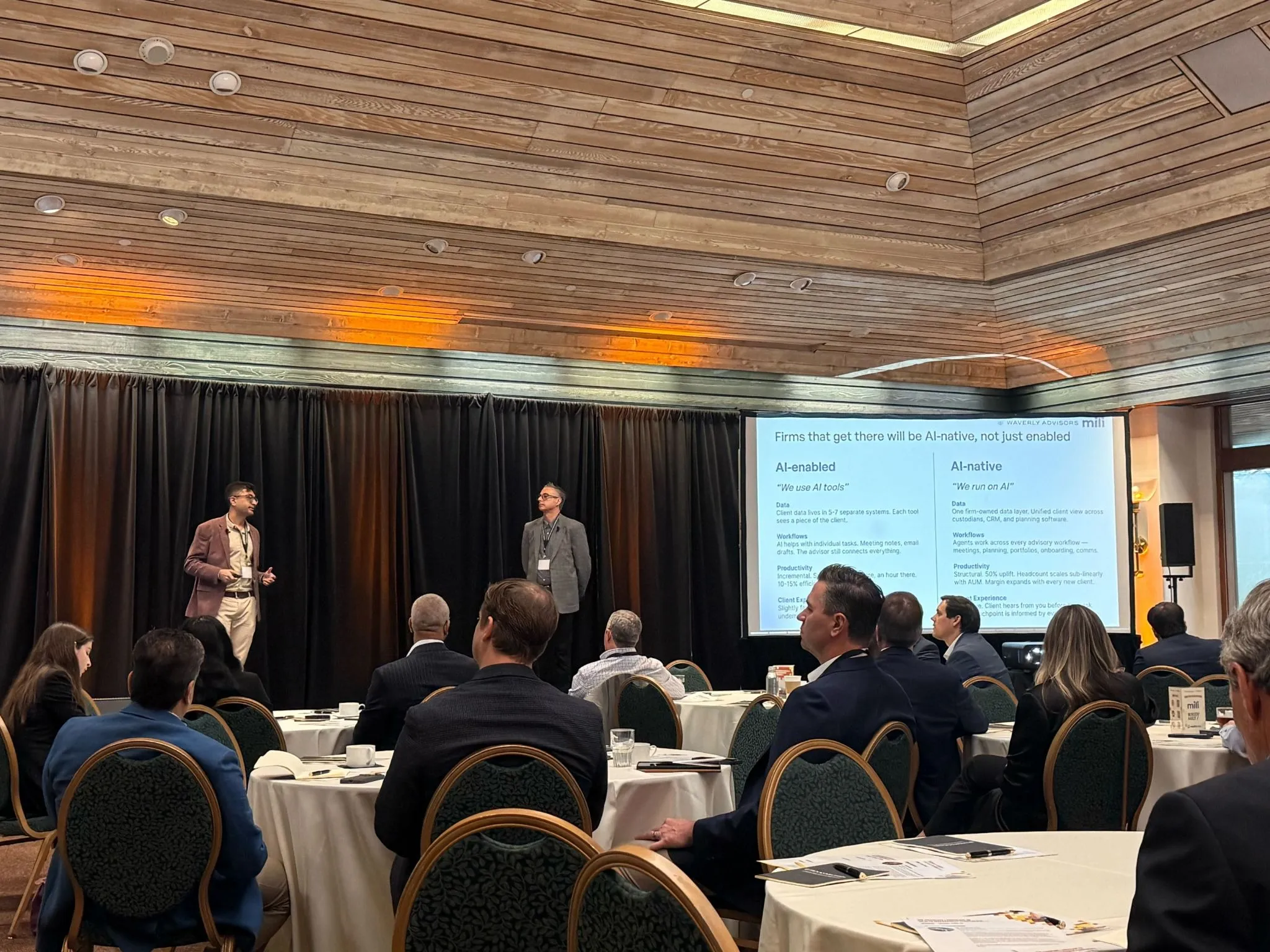
Chirag Gandhi was on the ground accompanied by Tom Brown, Partner and Regional Director at Waverly Advisors and a Mili client, for the AI session. The room had a lot of follow-up questions. That is always a good sign.
What an AI-Native Operating Model Actually Looks Like
The session Chirag and Tom ran together focused on what an AI-native operating model looks like for a firm managing significant AUM across thousands of client households. Tom brought the practitioner view: what it actually feels like to run a firm where technology is doing real work, where the efficiency gains are measurable, and where the transition from traditional workflows to agent-assisted ones has already happened.
The through-line of the session: your data still sits in silos. One piece in the CRM. Another in the financial plan. Another in the custodian. AI agents can only be as good as the data they can see. Solving for the unified data layer, building a system where all of that information is accessible, current, and connected is the real infrastructure decision every firm is sitting with right now.
That framing landed with the room. The firms in that session have the tools. The question is whether those tools are actually talking to each other, and whether the information flowing through them is reliable enough for AI agents to act on it with confidence.
Three Disruptions, and Most Firms Are Still on the First One
Brad Lawler of Provost made a point that cut through the noise of how AI conversations usually go. The main blocker to adoption, he said, is rarely the technology itself. It is change management. Getting people to work differently is harder than finding the right tools.
He also laid out three disruptions he sees unfolding in the industry, each at a different stage. The operational disruption is already here: firms automating the administrative and data management layer of their work. The structural disruption is next: changes to how firms are organised and how roles are defined as AI takes on more of the workflow. The generational disruption is further out: a fundamentally different kind of advisory practice built from the ground up around AI. Most firms, he noted, are still working through the first one.
That sequencing was useful. It gave a room of firm leaders a practical lens for where they are in the process and what to focus on now versus later. For most of the people in that room, the priority is getting the operational layer right. That is where Mili lives.
The Relationship Still Matters. The Wrapper Is Changing.
Stephen de Man, Practice Management Regional Director at Dimensional Fund Advisors, put the stakes plainly. Advisors who do not adopt AI will be replaced by competitors who use it effectively. The relationship still matters. The wrapper around it is changing.
That framing is worth sitting with. The advisory relationship, the trust, the judgment, the ability to help a client make a good decision at a difficult moment, none of that is going away. What is changing is everything that surrounds it. The preparation. The documentation. The follow-through. The consistency across a book of hundreds of clients. Those are exactly the workflows AI agents are built to handle.
Nobody Is Asking Whether Anymore
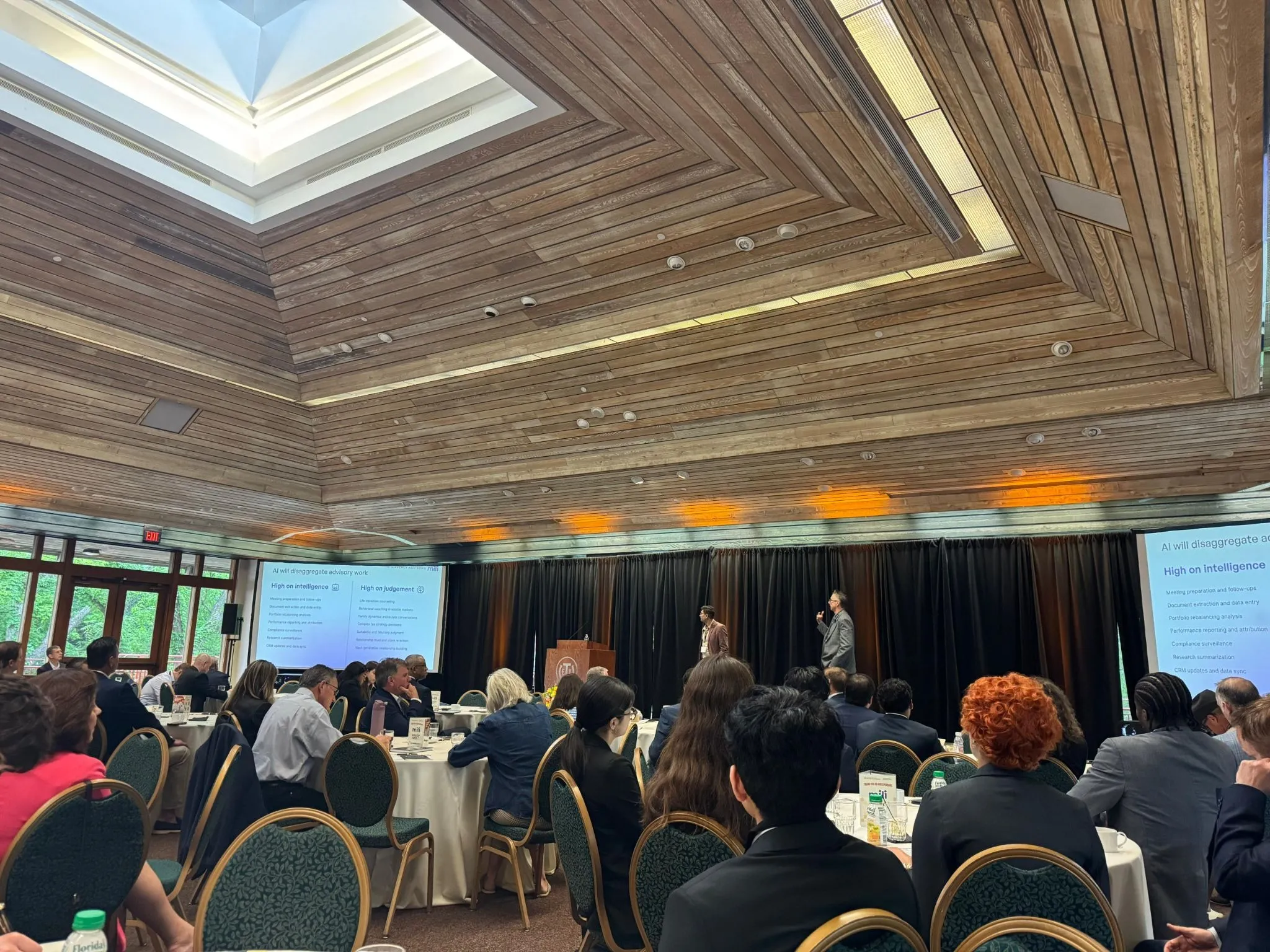
The conversations off stage were as telling as anything on it. The questions firms are asking have shifted. Nobody at this conference was asking whether to look at AI. They were asking how to build it into their practice without breaking what is already working.
That is a meaningful place to be. It means the industry has moved past the evaluation phase and into the implementation phase. The follow-up questions after the Chirag and Tom session reflected that: how do you get your team to adopt new workflows? How do you know the data going into the agents is clean enough to trust? How do you sequence the rollout across a firm of 30 or 50 advisors?
These are operational questions from people who have made their decision. And they are exactly the questions Mili is built to answer.
See You Next Year, Austin
The McCombs setting gave these conversations a quality that pure industry events sometimes miss. There is a rigour that comes from academic involvement, a willingness to ask harder questions and sit with more nuanced answers. For a topic as consequential as how AI reshapes advisory practices, that is exactly the right environment.
We are taking a lot home from Austin. The data silos framing from the session. The three-disruption sequencing from Brad Lawler. Stephen de Man's observation about the wrapper changing. These are the kinds of insights that sharpen how we build and how we talk about what we are building.
Thank you to the Langston Wealth Management Center and Texas McCombs School of Business for putting together a conference that brings the right people into the same room. And to Tom Brown for joining us on stage. See you next year, Austin.